The India Centre
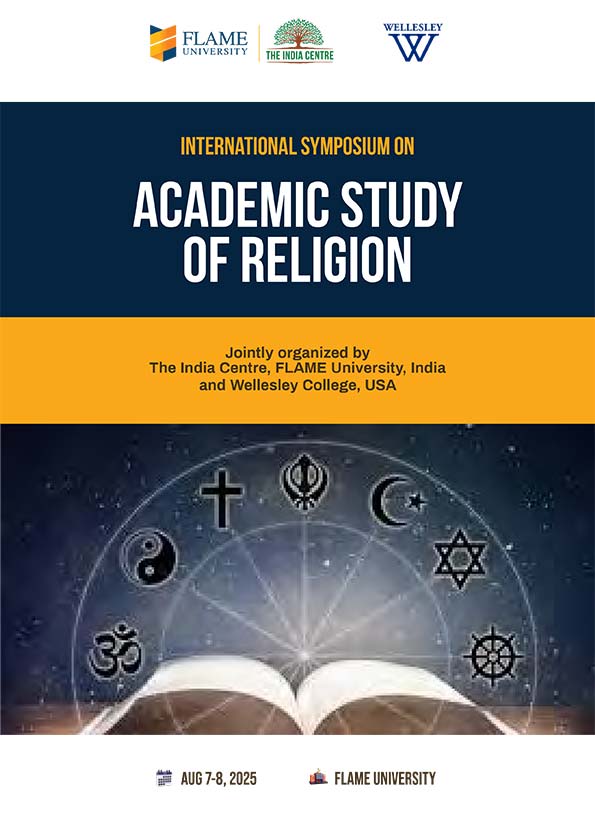
Symposium
Indian Knowledge Systems: Webinars
India Studies Webinar | Ancient Indian Astronomy Efforts to Achieve the Right Model of Planetary
FLAME University’s India Centre hosted the 37th webinar on India Studies, featuring Dr Shylaja B S., Visiting Scientist, Bangalore Association for Science Education, Jawaharlal Nehru Planetarium, Bangalore. Titled ‘Ancient Indian Astronomy – efforts to achieve the right model of planetary motion,’ the talk will outline the methods used by Indian astronomers to predict planetary positions and trace how these techniques advanced from Aryabhata through later scholars. The session will highlight the analytical approaches and scientific progression embedded in this longstanding tradition.
Dr B. S. Shylaja worked on the binary stars with Wolf-Rayet components for her doctoral thesis. She continued her research on comets, dwarf novae, and magnetic and metallic (Am) stars. She has authored 150 research papers in astronomy and the history of astronomy. After joining the Planetarium, she engaged in educational activities, including teaching on weekends, producing sky theatre shows, and conducting outreach. She worked on various interactive demonstrations and models and taught a range of age groups. Currently, she is working on the history of astronomy in India, focusing on medieval-period manuscripts, stone inscriptions, and temple architecture.
The power of DI - Dance Intelligence: Illustrated Lectureon Bharatanatyam
In the era of AI, Geeta Chandran propounds DI – Dance Intelligence as a human and humane response to the world of learning, aesthetics, and inner beauty. Based on her over five decades of engagement with Bharatanatyam, the lecture explores linkages between body and mind; forging relationships between solo dancing, group dancing, and choreography; actualising the connections between the artist and society; and using dance as a medium for expressing abstract notions of Joy, Beauty, Values, Aspirations, Mythology, and Spirituality.
Her vision of DI probes the continuing relevance of classical tradition in a world of changing values; showcasing the aesthetics of Bharatanatyam and its history, how the tenets of the dance can be employed as a means of communicating issues of contemporary concern, even while exploring linkages between history and continuity, between external body and internal mind-space, between yesterday and tomorrow, between artist and audience…………between roots and wings.
India Studies Webinar | Tripathagamini Ganga: The Intersectional Flows of the River in Indian
The paper focuses on human-river entanglements as they emerge in the textual and lived religious traditions of various Indian communities. In this paper, Prof. Pritha Chakraborty argues that the understanding of religion and ecology in India requires engaging with both the mythical/sacred and experiential/secular frameworks that shape Hindu life and its ecological implications. In this light, the paper explores the rich and complex representations of the River Ganga across diverse Indian literary and cultural traditions. The lecture will provide insights into the diverse representations, ranging from her portrayal as a goddess in Puranic literature to her presence in the folk and vernacular traditions of West Bengal, as well as the experiential narratives of riverine communities in Varanasi and West Bengal. It traces the depiction of Ganga as a goddess in Puranic and epic literatures to the Mangalkavyas and Puthis of West Bengal and Bangladesh, underlining the regional adaptations and religio-cultural aspects of the river. It also engages with the oral narratives and folksongs of the Nishads, Doms, Kaivartas, and Namashudras, who draw sustenance from the river, highlighting the religious, ecological, and economic significance of the river among the Antaja riverine communities. It concludes with a discussion on Amitav Ghosh’s The Hungry Tide, underlining how Indian river fiction connects the multiple currents of the river to depict the entanglements of human and nature.
India Studies Webinar | The power of DI - Dance Intelligence: Illustrated Lectureon Bharatanatyam
In the era of AI, Geeta Chandran propounds DI – Dance Intelligence as a human and humane response to the world of learning, aesthetics, and inner beauty. Based on her over five decades of engagement with Bharatanatyam, the lecture explores linkages between body and mind; forging relationships between solo dancing, group dancing, and choreography; actualising the connections between the artist and society; and using dance as a medium for expressing abstract notions of Joy, Beauty, Values, Aspirations, Mythology, and Spirituality.
Her vision of DI probes the continuing relevance of classical tradition in a world of changing values; showcasing the aesthetics of Bharatanatyam and its history, how the tenets of the dance can be employed as a means of communicating issues of contemporary concern, even while exploring linkages between history and continuity, between external body and internal mind-space, between yesterday and tomorrow, between artist and audience…………between roots and wings.
India Studies Webinar | The concept of “Prayer in the Periphery”
In this talk, drawing from philosophical theology and phenomenology, Prof. Hatcher will explore the concept of “Prayer in the Periphery,” an inquiry into the possibility of unceasing prayer as envisioned in 1 Thessalonians 5:17. Through the lens of contextual and marginal awareness, as articulated by Gurwitsch and Arvidson, he will examine how individuals might attune themselves to the divine voice while navigating the rhythms of everyday life.
India Studies Webinar | Panel 4: Historical Studies of Religion
Stephen A. Marini
Religious Studies and the Public Square: The Case of American Revolutionary Religion
Shruti Dixit
Interreligious Studies in India: Engaging with Raimon Panikkar’s Theology
Pankaj Jain
Closing Remarks
India Studies Webinar | Panel 3: Philological and Textual Studies
Louise Marlow
Religious Studies and Interdisciplinarity: A Case Study in Islamic Cultural Studies
R. Krishnaswamy and Tarinee Awasthi
The Devotee’s Dilemma: Surrender and Agency in Bhakti
Shikha Sharma
Gender Issues and Socio-centric Spirituality in Jain Tradition with reference to Acharya Chandana’s Life
India Studies Webinar | Panel 2: Psychological and Philosophical Perspectives on Religion
Pankaj Jain
Freudian Psychoanalysis And Indian Psychology
Nitya Pawar
Bhakti Beyond Religion: Fostering Hope Through Translation and Performance
Pranav Ambardekar
R. D. Ranade’s Mystical Conception of Avatārahood
Madhu Khanna
The Semiotics of the Nityāṣoḍaśīkārṇava Tantra: A Performative Text or a Document of Cultural Memory?
India Studies Webinar | Panel 1: Anthropological Approaches to Religion (the rest)
Alexandra Verini
Sisters as Ethnographers: Documenting Colonial India in the Loreto Schools
Holly Walters
Shaligrams in a Dark Digital River: Decolonizing Ritual Practice Through the Online Exchange of Sacred Stones
India Studies Webinar | Inauguration and Opening Remarks
M.A. Venkataramanan
Inauguration
Neelima Shukla-Bhatt
Keynote: The Case for Introducing the Academic Study of Religion in India
India Studies Webinar | Modern Jain Women Activists: From Householders to Ascetics
In this talk, Prof. Howard will explore the legacy of the Sarabhai family and discuss how Jainism-often seen as a renunciatory tradition centered on nonviolence and monastic life—has shaped women’s roles. She will highlight the role of modern Jain women who, as householders, social activists, and ascetics, are redefining liberation and working toward women’s empowerment and the upliftment of marginalized communities. This discussion will provide fresh insights into gender and women’s issues in contemporary society.
Religious Pluralism to Religious Cosmopolitanism: Revisiting Sri Ramakrishna & Swami Vivekananda
Join Swami Medhananda, Monk of the Ramakrishna Order, an Academic Philosopher, and Senior Research Fellow in Philosophy at the Vedanta Society of Southern California for a thought-provoking session on “From Religious Pluralism to Religious Cosmopolitanism: Revisiting Sri Ramakrishna & Swami Vivekananda.”
Explore the profound philosophies of the Bengali mystic Sri Ramakrishna (1836–1886), who taught the timeless dictum, “As many faiths, so many paths.” Ramakrishna upheld that various religions, while different, are equally effective paths to the ultimate goal of experiential knowledge of the Infinite Divine, whether as a personal God, the Buddhist nirvāṇa, or the Advaitic realization of nondual Pure Consciousness. His teachings challenge monolithic views of religious pluralism and affirm the equal value of multiple spiritual goals.
Swami Vivekananda, his chief disciple, expanded these ideas into a radical religious cosmopolitanism, advocating the ideal of learning from other religions and fostering multiple religious belongings.